-
Examining the psychological and behavioral science principles, including cognitive bias, loss aversion, subconscious decision-making, and the influence of deeply held healthcare stereotypes, that drive predictable patterns in patient behavior, and explaining how these principles position teams to anticipate patient needs, engage in interactions that are genuinely attentive, and increase case acceptance for the benefit of patient health outcomes
-
Applying the principles of choice architecture and deliberate environmental design to key patient decision-making points within the practice, constructing a practice environment that improves case acceptance rates while preserving patient autonomy and reinforcing confidence in provider intent
-
Applying theory of mind and cognitive flexibility to patient interactions involving misaligned expectations or active conflict and implementing research-supported conflict resolution strategies that produce mutually beneficial outcomes without placing unsustainable emotional burden on the team members responsible for managing those interactions
-
Integrating behavioral science, deliberate choice design, and patient communication competencies into a cohesive patient experience ideology that consistently reduces uncertainty, improves case acceptance, and equips teams with the interpersonal tools and organizational support structures needed to sustain high-quality patient engagement without risk of emotional exhaustion
build trust and support patients on a deeper level.
Patients arrive at every dental appointment shaped by subconscious motivations and cognitive biases. Practices that understand those forces are considerably better positioned to anticipate patient needs, reduce resistance to treatment, and build the kind of trust that converts single visits into long-term patient relationships. This three-session series equips teams with evidence-based systems drawn from behavioral science, decision psychology, and interpersonal communication research to design patient experiences that feel genuinely supportive. Each session builds deliberately on the last, moving from understanding why patients behave as they do, to designing the environments and interactions that guide better decisions, to developing the communication competencies required when those interactions become difficult.
Recommended Audience: All Positions
Series Duration: 6 Hours - (3) 2 Hour Sessions
AGD PACE Subject Codes Recommendation: 149, 153, 550
PATIENT PSYCHOLOGY SERIES.
SERIES OBJECTIVES
SERIES INVESTMENT: $2,250
Patients are healthcare consumers, and consumer behavior is largely predictable. Supported by decades of research across psychology, behavioral economics, and neuroscience, this session identifies consistent patterns in patient behavior to equip practices with the understanding needed to anticipate the needs of their patient population. In unfamiliar or stressful situations, people respond favorably when their needs are anticipated, provided that effort feels genuine rather than calculated. This session also provides practical measures for ensuring that proactive interactions are experienced as attentive and supportive rather than controlling or self-serving.
SESSION I OBJECTIVES
-
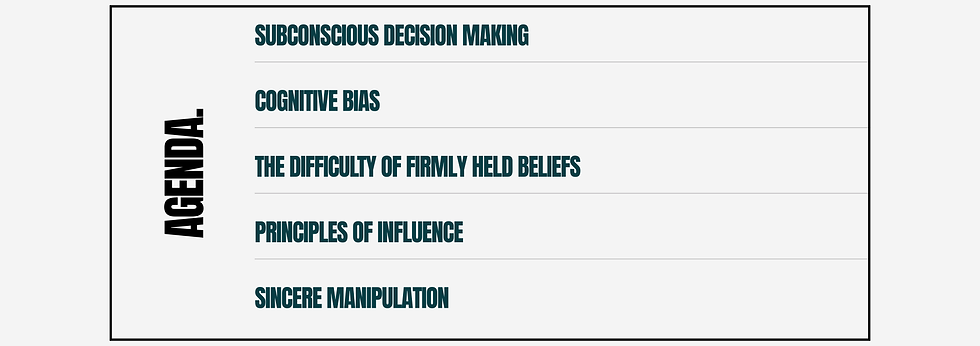
Examining how individuals develop motivations to act and how most of those decisions occur below the threshold of conscious awareness
-
Exploring how loss aversion and associated principles of cognitive bias influence patient decisions to pursue and accept treatment
-
Examining how deeply ingrained stereotypes of healthcare and dental providers affect certain patient populations, and identifying approaches for overcoming those perceptions
-
Applying the principles of influence to anticipate patient needs more accurately, develop more positive patient experiences, and improve treatment compliance
-
Recognizing, avoiding and mitigating common interpersonal and typical healthcare setting pitfalls that lead patients to perceive actions as manipulative



SESSION II OBJECTIVES
Choice architecture shapes decision-making in nearly every consumer context yet it remains largely absent from healthcare settings. Dental practices that apply the psychological principles of deliberate choice architecture and a thoughtfully designed case presentation environment stand to improve both case acceptance rates and positive patient outcomes. This session explains the psychology behind effective choice architecture, how to develop it within a practice context, and what distinguishes successful design from poor design. Motivating patients to accept treatment that advances their well-being requires a deliberate approach: one that reduces uncertainty, offers comfortable defaults, and preserves freedom of choice while guiding patients toward options that benefit their health.
-
Introducing the concept of nudging as a technique for supporting patient decision-making when the volume, complexity, or accessibility of information required to make an informed choice is a barrier to action
-
Examining successful and unsuccessful attempts to influence patient decision-making within healthcare settings across academic research, private practice, and government agency intervention
-
Applying choice architecture to key decision-making points within the patient experience to establish helpful defaults, frame available choices more effectively, and present supporting information in a way that accounts for the cognitive challenges of an unfamiliar environment
-
Identifying consistent patterns in patient perceptions of comfort to inform the design of environments and interactions that reduce uncertainty and support a genuine sense of ease
-
Recognizing, avoiding, and mitigating errors in applied influence that result in inadvertent erosion of patient independence or confidence in provider intent


SESSION III OBJECTIVES
Managing expectations and resolving conflict are closely related competencies but they require markedly different approaches, in large part because the patient's mindset and goals differ between the two contexts. This session explores the psychology behind managing expectations and setting boundaries without compromising the patient experience, and the skills required to resolve conflict when it arises without placing emotional burden on team members tasked with addressing contention. Both competencies depend on cognitive flexibility, theory of mind, and a genuine commitment to working toward mutually beneficial outcomes.
-
Examining the sources of patient expectations about a dental visit and aligning those expectations with practice standards for patient compliance and behavior in a way that is balanced and decisive without assuming patients will respond as a provider would under the same circumstances
-
Introducing the concept of theory of mind to contextualize how patient expectations and approaches to conflict resolution are likely to differ from those of the same individual under less unfamiliar or stressful conditions
-
Applying cognitive flexibility to patient interactions where levels of comfort, confidence, and trust are unbalanced, adapting body positioning, tone, language, and openness to other perspectives to better reflect and respond to the patient's point of view
-
Establishing research-supported strategies for effective conflict resolution when proactive expectation management and needs anticipation have not prompted a productive patient-provider relationship
-
Developing support structures for team members whose roles require consistent emotional exertion, ensuring that those responsible for creating a secure patient environment are protected from the risk of emotional burnout


KEEP THE SERIES GOING.
The Patient Psychology Series can be supplemented by the following additional coursework add-ons:
THE ART OF COMMUNICATING SESSION
PATIENT CENTRIC EXPERIENCE SESSION
Effective communication is widely regarded as a skill, but it is more precisely understood as an art. Art requires personal expression, emotional intelligence, deliberate practice, and a working command of principles that, when applied well, reliably reach another person. Like art, the fundamentals can be taught. This session covers the research-backed communication fundamentals that produce meaningful impact: leveling power dynamics, practicing sincere active listening, asking the right questions in the right way, expressing empathy, conveying acknowledgment, and facilitating action.
This session distinguishes between the broad concept of patient experience and the deliberate process of curating a predictable, replicable positive experience at every stage of the patient journey - for every appointment, across every position on the team. Grounded in the principles of customer centricity and the behavioral psychology behind motivating action, this course provides a clear, applicable framework for delivering exceptional patient experiences through workflows that translate directly to daily practice.
Session Duration: 2 Hours
AGD PACE Course Code Recommendation: 550
Session Duration: 2 Hours
AGD PACE Course Code Recommendation: 550
SESSION INVESTMENT as add-on: $500
SESSION INVESTMENT as add-on: $500
SESSION OBJECTIVES
SESSION OBJECTIVES
-
Addressing the most common communication errors across three partner pairings: leadership and team, peer to peer, and provider and patient
-
Identifying patient experience stakeholders and each position’s contribution to the continuity of the experience
-
Examining evidence-based methods to improve active listening
-
Understanding the concept of customer centricity and applying that principle to creating patient profiles of the ‘right’ patients for the patient experience and brand identity the team intends to provide and replicate
-
Exploring why empathy has developed a poor reputation in professional settings and reviewing the research that supports the measurable benefits of intentionally empathetic communication
-
Considering the social psychology principles that define a predictable positive experience to initiative discussion within the practice about deliberate patient experience design
-
Facilitating productive action within conversations without sacrificing the social value built through leveled power dynamics, active listening, expressed empathy, and conveyed acknowledgment
-
Understanding the widely accepted and held ‘principles of influence’ to influence patient experience for the mutual benefit of the patient and the practice
-
Recognizing when communication is failing or has failed, and developing strategies to revisit difficult conversations with greater preparation and more constructive outcomes
-
Reviewing evidence-based strategies for consistently successful primary and secondary patient interactions
double-down on impact.
For practices seeking the greatest impact from their training investment, Lucent offers the following options:
%20-%203_125x%20Resolution.png)
For training sessions incorporated into continuing education programs or referral marketing initiatives, Lucent can provide seamlessly branded materials to support event promotion and deliver a cohesive attendee experience, including custom course flyers, optional discounted printing and shipping, and optional branded course materials such as handouts, program evaluations, and custom stationery.
branded materials
Remote training offers accessibility and scheduling flexibility without compromising session quality. For practices seeking deeper engagement with the material, on-site instruction provides a more immersive experience, with greater audience participation and a higher degree of personalization.
on-site instruction
Training content is designed to be broadly applicable and to stimulate innovation and collaborative problem-solving across the team. For practices seeking a more tailored experience, Lucent accepts Custom Content Proposals, developed following a complimentary Discovery call to determine the most effective approach to adapting existing material before training is scheduled.
customized content
For practices seeking the greatest impact from their training investment, Lucent offers the following options:
double-down on impact.

Complete the form below to start the process of booking your Patient Psychology Series.
Lucent will return your inquiry within 24-business hours.
Lucent is applying for AGD PACE approval for continuing education credit issuance for acceptance by state licensing boards; however, Lucent has not yet been approved and cannot issue continuing education credits at this time. Content is eligible for continued education credit if included as part of an existing AGD PACE approved continuing education program. AGD PACE Course Codes are provided for reference only.
CONTACT.
Image Credit to Alex Andrews