-
Developing a working knowledge of dental radiograph, including imaging modalities, anatomical landmarks, directional terminology, and the radiographic presentation of common findings, pathologies, and procedures, sufficient to support provider communication, accurately field patient questions about radiographic-based referrals, and recognize findings with immediate clinical significance without assuming a diagnostic role
-
Examining the scope and clinical relevance of oral medicine as a specialty, and its application to temporomandibular disorders, orofacial pain, peripheral nerve conditions, oral lesions, and salivary gland disorders to improve the consistency of specialist referrals, reduce the incidence of misdiagnosis, and strengthen the quality of clinical documentation supporting patient care transitions
-
Applying foundational knowledge of temporomandibular disorder encompassing its etiology, epidemiology, symptom presentation, the malocclusion relationship, conservative and surgical treatment options, and common documentation and insurance filing errors, to support accurate patient communication, appropriate provider screening referrals, and administratively reliable management of TMD-related referrals and insurance claims
-
Integrating clinical literacy across radiography, oral medicine, and temporomandibular disorder into a shared team competency that strengthens the referral process, improves patient-facing communication at underserved clinical touchpoints, and positions both administrative and clinical team members as more informed, effective contributors to patient care continuity and outcomes
support clinical discussions with confidence.
Administrative and clinical support team members are frequently positioned at the most consequential patient communication touchpoints fielding questions about radiographic findings, managing referrals, and supporting patients navigating conditions they have little understanding of. Yet, those same team members rarely receive the clinical education needed to perform those functions with confidence. This three-session series addresses that gap by equipping the team with a working, non-diagnostic clinical literacy across dental radiography, oral medicine, and temporomandibular disorder, providing the foundational knowledge needed to support provider communication, improve referral quality, strengthen clinical documentation, and reduce the patient uncertainty that most commonly arises at the intersection of administrative and clinical responsibility.
Recommended Audience: Administrative Assistants, Clinical Managers, Referral Coordinators, Scheduling Coordinators, Treatment Coordinators, RDHs, DAs
Series Duration: 6 Hours - (3) 2 Hour Sessions
AGD PACE Subject Codes Recommendation: 730, 731
CLINICAL SERIES.
SERIES OBJECTIVES
SERIES INVESTMENT: $2,250
The referral process, whether outbound from a general practice or inbound to a specialty office, is among the most commonly overlooked touchpoints in the patient experience. Administrative team members typically manage outbound and inbound referrals and are most likely to field patient questions about the reason for referral, particularly when that referral is based on a radiographic finding from the same visit. This session equips administrative positions with practical clinical basics in dental radiography, not to diagnose or offer clinical recommendations, but to develop a working understanding of the clinical basis for referral and to better support the provider when patients need clarification. Clinical team members are encouraged to attend as well, as the session serves as a useful refresher on anatomy and radiographic findings.
SESSION I OBJECTIVES
-
Reviewing the methods of dental radiography, selection criteria for each method, and high-level identification and prevention of technical capture errors that affect diagnostic image quality
-
Reviewing tooth structure and the descriptive directional and positional terminology relevant to qualified provider interpretation and diagnosis
-
Examining facial anatomy and anatomical landmarks relevant to qualified provider interpretation and diagnosis
-
Identifying radiographic findings with immediate clinical significance, as well as the presentation of common abnormalities, pathologies, and the radiographic appearance of routine dental procedures
-
Applying anatomical and radiographic knowledge to correlate panoramic findings with clinical presentation and applicable differential diagnoses


SESSION II OBJECTIVES
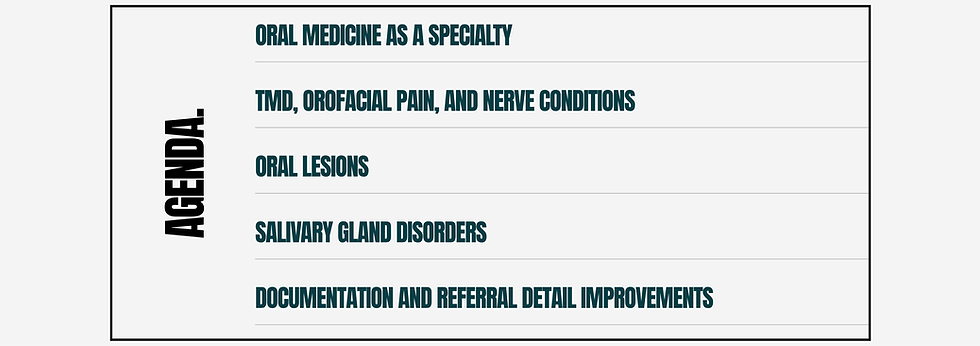
Oral medicine is a dental specialty that remains largely inaccessible in private practice settings, as it is predominantly found within academic medical centers with extended waitlists. This session brings awareness to a specialty that is significantly underrepresented in everyday dental practice, despite occupying a meaningful intersection of medicine and dentistry. The goal is to make referrals to available oral medicine specialists more consistent, reduce the incidence of misdiagnosis, and improve outcomes for patients presenting with idiopathic or undifferentiated conditions. The session highlights the categories of conditions most relevant to this discipline, including temporomandibular disorders, orofacial pain, peripheral nerve conditions, oral lesions, and salivary gland disorders.
-
Introducing the specialty of oral medicine and the common scope of practice for an oral medicine specialist
-
Reviewing foundational concepts associated with the first category of conditions addressed in oral medicine: temporomandibular disorders, orofacial pain, and peripheral nerve conditions
-
Reviewing foundational concepts associated with the second category of conditions addressed in oral medicine: oral lesions
-
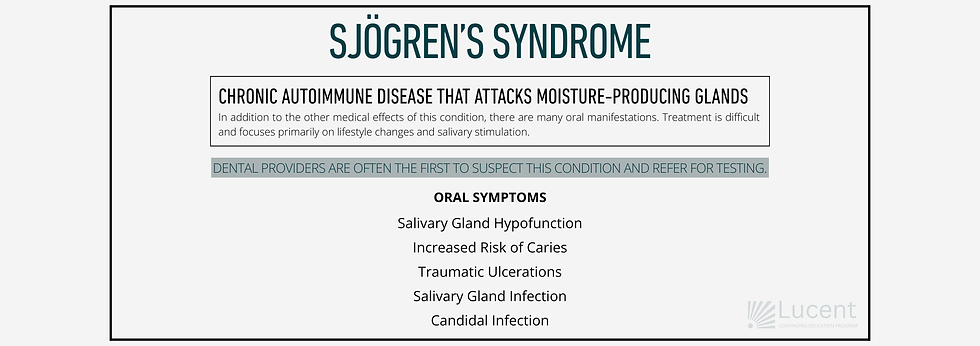
Reviewing foundational concepts associated with the third category of conditions addressed in oral medicine: salivary gland disorders
-
Applying foundational knowledge of oral lesions to improve clinical documentation and referral detail, expediting patient care and establishing a more descriptive clinical history



SESSION III OBJECTIVES
Meta-analyses indicate that the prevalence of temporomandibular disorder (TMD) is high globally, and likely higher than formally reported, given that routine screening remains inconsistent, particularly among the pediatric and male populations. This session addresses the non-clinical aspects of TMD to equip both administrative and clinical team members with a working understanding of the condition: recognizing potential symptoms, interpreting patient descriptions, identifying when a provider screening may be warranted, conservative therapies, available surgical interventions, and insurance obstacles related to the treatment of TMD. The session also addresses common misconceptions and myths surrounding TMD as it is frequently mischaracterized in popular culture.
-
Introducing the anatomy and physiology relevant to the assessment, diagnosis, management, and treatment of TMD
-
Reviewing the etiology, epidemiology, symptoms, presentation, and progression of the disorder
-
Examining the association between malocclusion and temporomandibular disorder as it relates to clinical consideration of occlusal guards
-
Evaluating available conservative treatments, management modalities, and surgical interventions
-
Recognizing, avoiding, and mitigating common documentation and insurance filing errors related to the management and treatment of TMD


KEEP THE SERIES GOING.
The Clinical Series can be supplemented by the following additional coursework add-ons:
Dental Implants 101: Introduction to Dental Implants and Digital Workflows Session
Dental Implants 201: Full Arch Restoration Session
Dental implants are among the most frequently recommended treatments in general and specialty practice, particularly as the patient population continues to age. This session was developed in response to a consistently observed disparity in dental implant knowledge among members of the same office team: in nearly every practice, at least one team member acknowledged having told a patient they knew little about dental implants. This session covers the clinical fundamentals of dental implants, including clinical indications for placement, patient identification, dental implant structure as it relates to patient anatomy, clinical benefits, alternatives to placement, the basics of restoration, patient education language, and common misconceptions. This session is not a sales course - the content is clinical, but adjusted for application by administrative and clinical team members to improve patient education, patient experience, and patient outcomes.
The rise of direct-to-consumer advertising for same-day smile restorations has generated a significant increase in patient inquiries, making it more important than ever for administrative and clinical teams to be equipped with the detailed knowledge required to respond accurately and confidently. Building on the dental implant fundamentals covered in Dental Implants 101, this session addresses larger and more complex dental implant cases and their alternatives. The session covers clinical indications for assessing the most appropriate treatment - whether preparation for a traditional denture, a dental implant-supported overdenture, or a dental implant-retained All-on-X restoration - as well as the clinical benefits of treatment, the risks of delayed treatment, complex placements using zygomatic and pterygoid dental implants, the surgical and restorative processes, and patient education language. This session is not a sales course - the content is clinical, but adjusted for application by administrative and clinical team members to improve patient education, patient experience, and patient outcomes.
Session Duration: 2 Hours
AGD PACE Course Codes Recommendation: 670, 690
Session Duration: 2 Hours
AGD PACE Course Codes Recommendation: 610, 690
SESSION INVESTMENT as add-on: $500
SESSION INVESTMENT as add-on: $500
SESSION OBJECTIVES
SESSION OBJECTIVES
-
Introducing dental implants as a treatment option for edentulism, including dental implant structure and materials, and the anatomy relevant to immediate and long-term dental implant success
-
Introducing the three full-arch rehabilitation treatment options and their clinical indications: preparation for a traditional denture, a dental implant-supported overdenture, or a dental implant-retained All-on-X restoration
-
Evaluating patient health histories and clinical presentations for dental implant candidacy, and addressing common misconceptions about circumstances that may disqualify a patient from consideration
-
Introducing zygomatic and pterygoid dental implants and other potential case complexities relevant to full-arch rehabilitation planning
-
Examining clinical indications, benefits, and alternatives for dental implant placement
-
Reviewing the clinical and financial planning processes associated with larger full-arch rehabilitation cases
-
Reviewing the surgical, healing, and restoration processes, including single- and two-stage placement workflows, common pre- and post-operative patient concerns, potential restorative complications, and the digital technologies that reduce planning, procedure, and healing times
-
Reviewing the surgical, healing, and restoration processes, including common pre- and post-operative patient concerns, potential restorative complications, and the digital technologies that reduce planning, procedure, and healing times
-
Applying dental implant knowledge to patient education materials and in-office communication related to treatment planning, financial planning, the specialty referral process, and pre- and post-operative patient questions
-
Applying knowledge of full-arch treatment options to patient education materials and in-office communication related to treatment planning, financial planning, the specialty referral process, and pre- and post-operative patient questions
double-down on impact.
For practices seeking the greatest impact from their training investment, Lucent offers the following options:
%20-%203_125x%20Resolution.png)
For training sessions incorporated into continuing education programs or referral marketing initiatives, Lucent can provide seamlessly branded materials to support event promotion and deliver a cohesive attendee experience, including custom course flyers, optional discounted printing and shipping, and optional branded course materials such as handouts, program evaluations, and custom stationery.
branded materials
Remote training offers accessibility and scheduling flexibility without compromising session quality. For practices seeking deeper engagement with the material, on-site instruction provides a more immersive experience, with greater audience participation and a higher degree of personalization.
on-site instruction
Training content is designed to be broadly applicable and to stimulate innovation and collaborative problem-solving across the team. For practices seeking a more tailored experience, Lucent accepts Custom Content Proposals, developed following a complimentary Discovery call to determine the most effective approach to adapting existing material before training is scheduled.
customized content
For practices seeking the greatest impact from their training investment, Lucent offers the following options:
double-down on impact.

Complete the form below to start the process of booking your Clinical Series.
Lucent will return your inquiry within 24-business hours.
Lucent is applying for AGD PACE approval for continuing education credit issuance for acceptance by state licensing boards; however, Lucent has not yet been approved and cannot issue continuing education credits at this time. Content is eligible for continued education credit if included as part of an existing AGD PACE approved continuing education program. AGD PACE Course Codes are provided for reference only.
CONTACT.
Image Credit to Alex Andrews