AD-HOC SESSIONS + WORKSHOPS.
Effective communication is widely regarded as a skill, but it is more precisely understood as an art. Art requires personal expression, emotional intelligence, deliberate practice, and a working command of principles that, when applied well, reliably reach another person. Like art, the fundamentals can be taught. This session covers the research-backed communication fundamentals that produce meaningful impact: leveling power dynamics, practicing sincere active listening, asking the right questions in the right way, expressing empathy, conveying acknowledgment, and facilitating action.
Recommended Audience: All Positions
Session Duration: 2 Hours
AGD PACE Subject Code Recommendation: 550
SESSION INVESTMENT: $750
SESSION OBJECTIVES
-
Addressing the most common communication errors across three partner pairings: leadership and team, peer to peer, and provider and patient
-
Examining evidence-based methods to improve active listening
-
Exploring why empathy has developed a poor reputation in professional settings and reviewing the research that supports the measurable benefits of intentionally empathetic communication
-
Facilitating productive action within conversations without sacrificing the social value built through leveled power dynamics, active listening, expressed empathy, and conveyed acknowledgment
-
Recognizing when communication is failing or has failed, and developing strategies to revisit difficult conversations with greater preparation and more constructive outcomes




Whether completed for the first time to develop or refine a practice identity, or completed on a recurring basis to remain current with market conditions, a thorough market evaluation is consequential to sensible operational decision-making. This session provides a focused examination of the key elements of a well-rounded market evaluation, covering competitor analysis, patient demographics, and the local and national political and socioeconomic factors that shape the market, because gaps in market awareness can result in unintended costly missteps.
Recommended Audience: Office Managers, Marketing Managers, Practice Owners
Session Duration: 2 Hours
AGD PACE Subject Code Recommendation: 550
SESSION INVESTMENT: $750
SESSION OBJECTIVES
-
Dispelling the assumption that a SWOT analysis is the appropriate starting point for a market evaluation, and introducing a more constructive framework for assessing internal and external factors, one that produces a wider range of actionable outcomes from the evaluation process
-
Explaining the distinction between direct and indirect competitors, and how each category affects positioning and patient acquisition strategy
-
Reviewing the demographic data available within the market, including age distribution, household income, insurance coverage rates, employment base, and population growth trends, and how each variable informs targeted operational or marketing adjustments
-
Identifying the local and national policy, regulatory, and socioeconomic conditions most likely to influence patient access, payor mix, and provider demand within the market, and describe how shifts in those conditions demand corresponding adjustments to operational and marketing strategies
-
Developing a repeatable market evaluation framework to support periodic review and produce actionable, decision-ready outputs without recurring unsustainable administrative burden with each iteration



Continuing education and professional development should extend beyond the requirements of state board licensure renewal and research supports the case for making those experiences genuinely engaging. Retention improves with increased dopamine levels, and the conditions that produce enjoyable learning experiences are well-documented and reproducible. This session provides the tools needed to establish a continuing education program, a study club, or both, beginning with identifying whether and what type of program is a good fit for the market. The session draws from direct experience developing a successful regional continuing education program for a specialty group that hosted over 400 attendees, averaged 1.5 events per month, and sustained consistent year-over-year growth in participation.
Recommended Audience: Office Managers, Marketing Managers, Practice Owners
Session Duration: 2 Hours
AGD PACE Subject Code Recommendation: 550
SESSION INVESTMENT: $750
SESSION OBJECTIVES
-
Identifying when a continuing education program, a study club, or both would provide meaningful value, whether as a referral development tool or as an expression of good will within the local dental community
-
Developing the administrative structure required to manage a continuing education program or study club with efficiency and consistency, up to AGD PACE approval standards, including budgeting, attendance and certification management, marketing and promotion, and venue and speaker logistics
-
Examining the methodology behind building an event brand that drives attendance, encourages self-promotion, and contributes to overall program success
-
Designing an event atmosphere that supports active participation, content retention, and attendee satisfaction
-
Recognizing, avoiding, and mitigating common program and event management challenges, including low reservation rates, high no-show rates, poor course evaluations, waitlist management, attendance cap constraints, and the growing cost of improving the program experience


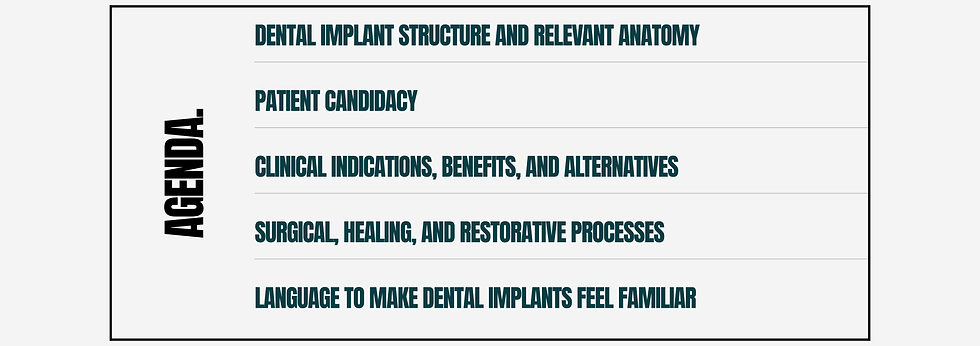
Dental implants are among the most frequently recommended treatments in general and specialty practice, particularly as the patient population continues to age. This session was developed in response to a consistently observed disparity in dental implant knowledge among members of the same office team: in nearly every practice, at least one team member acknowledged having told a patient they knew little about dental implants. This session covers the clinical fundamentals of dental implants, including clinical indications for placement, patient identification, dental implant structure as it relates to patient anatomy, clinical benefits, alternatives to placement, the basics of restoration, patient education language, and common misconceptions. This session is not a sales course - the content is clinical, but adjusted for application by administrative and clinical team members to improve patient education, patient experience, and patient outcomes.
Recommended Audience: All Positions
Session Duration: 2 Hours
AGD PACE Subject Codes Recommendation: 670, 690
SESSION INVESTMENT: $750
SESSION OBJECTIVES
-
Introducing dental implants as a treatment option for edentulism, including dental implant structure and materials, and the anatomy relevant to immediate and long-term dental implant success
-
Evaluating patient health histories and clinical presentations for dental implant candidacy, and addressing common misconceptions about circumstances that may disqualify a patient from consideration
-
Examining clinical indications, benefits, and alternatives for dental implant placement
-
Reviewing the surgical, healing, and restoration processes, including single- and two-stage placement workflows, common pre- and post-operative patient concerns, potential restorative complications, and the digital technologies that reduce planning, procedure, and healing times
-
Applying dental implant knowledge to patient education materials and in-office communication related to treatment planning, financial planning, the specialty referral process, and pre- and post-operative patient questions



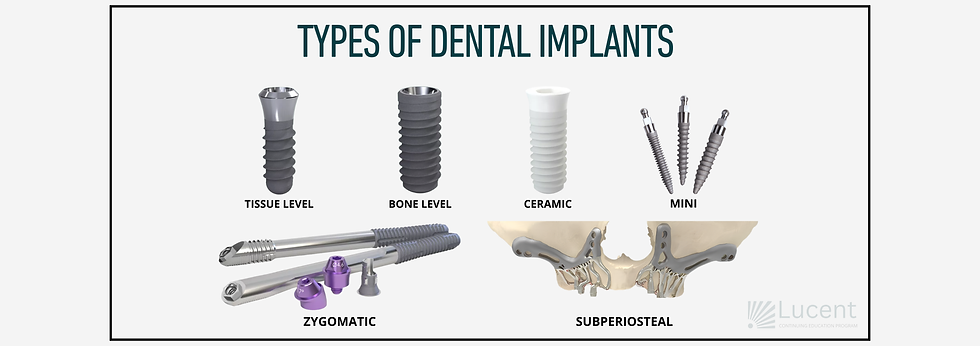
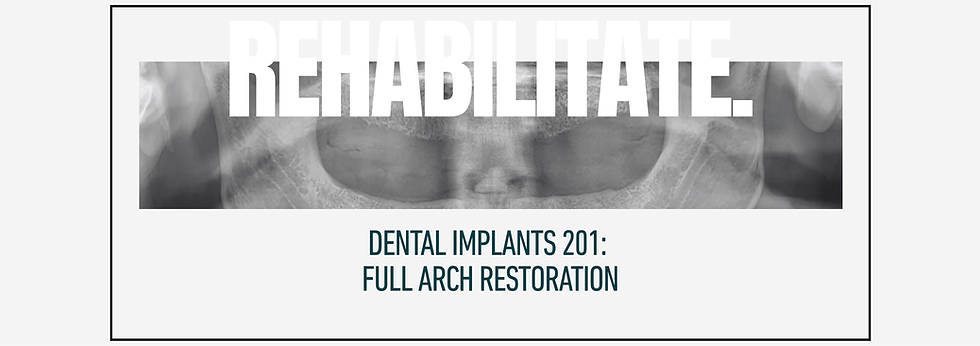
The rise of direct-to-consumer advertising for same-day smile restorations has generated a significant increase in patient inquiries, making it more important than ever for administrative and clinical teams to be equipped with the detailed knowledge required to respond accurately and confidently. Building on the dental implant fundamentals covered in Dental Implants 101, this session addresses larger and more complex dental implant cases and their alternatives. The session covers clinical indications for assessing the most appropriate treatment - whether preparation for a traditional denture, a dental implant-supported overdenture, or a dental implant-retained All-on-X restoration - as well as the clinical benefits of treatment, the risks of delayed treatment, complex placements using zygomatic and pterygoid dental implants, the surgical and restorative processes, and patient education language. This session is not a sales course - the content is clinical, but adjusted for application by administrative and clinical team members to improve patient education, patient experience, and patient outcomes.
Recommended Audience: All Positions
Session Duration: 2 Hours
AGD PACE Subject Codes Recommendation: 670, 690
SESSION INVESTMENT: $750
SESSION OBJECTIVES
-
Introducing the three full-arch rehabilitation treatment options and their clinical indications: preparation for a traditional denture, a dental implant-supported overdenture, or a dental implant-retained All-on-X restoration
-
Introducing zygomatic and pterygoid dental implants and other potential case complexities relevant to full-arch rehabilitation planning
-
Reviewing the clinical and financial planning processes associated with larger full-arch rehabilitation cases
-
Reviewing the surgical, healing, and restoration processes, including common pre- and post-operative patient concerns, potential restorative complications, and the digital technologies that reduce planning, procedure, and healing times
-
Applying knowledge of full-arch treatment options to patient education materials and in-office communication related to treatment planning, financial planning, the specialty referral process, and pre- and post-operative patient questions



Dental literacy is considerably lower than medical literacy and that gap creates a two-directional challenge: patients without a foundational understanding of dental health struggle to describe their concerns in ways their care team can effectively act on, and care teams without the right communication tools struggle to bridge that gap. This gap requires that patient education materials be dual-purpose, reducing the communication barrier of both the patient and the provider. This workshop evaluates existing patient education materials within the practice against key indicators of effective patient-provider communication. Where materials fall short of patient needs or are absent entirely, the workshop provides actionable takeaways for strengthening what exists, whether online, digital in-office, or in print. All materials are assessed using criteria grounded in behavioral and social psychology, public health research, and cognitive design principles.
Recommended Audience: Clinical Managers, Office Managers, Treatment Coordinators, Practice Owners
Workshop Duration: 3 Hours
AGD PACE Subject Code Recommendation: 550
WORKSHOP INVESTMENT: $1,000
WORKSHOP OBJECTIVES
-
Evaluating interactions between patients, providers, and the team that produce recurring friction from simple misunderstandings through non-compliance and conflict
-
Identifying opportunities where a targeted tool or resource could facilitate more productive communication toward a mutually beneficial administrative or clinical outcome
-
Assessing the effectiveness of existing material design for its intended purpose, including layout and formatting, length and content complexity, text-to-image ratio, and accessibility across patient demographics
-
Evaluating the total volume and frequency of patient education materials and conversations presented within a single appointment, in preparation for a procedure, or in follow-up, ensuring the information provided does not exceed what can be reasonably retained
-
Examining how the method and environment in which materials are presented influence their impact on the patient
A common fallacy among specialty practices is that referral management requires minimal operational investment. For specialties that depend on referral volume, it is among the most consequential operational priorities and treating it as an afterthought carries meaningful risk. The same psychology that drives patient behavior applies equally to the decision-making of referring providers. This session establishes that a successful referral management strategy mirrors the same intentionality behind a consistent and predictable patient experience, because the most reliable driver of referral volume is the confidence a specialty practice instills in the referring provider that their patients will be well served. That confidence is built and sustained through the quality of the referral experience and relationship management itself.
Recommended Audience: Office Managers, Marketing Managers, Practice Owners
Session Duration: 2 Hours
AGD PACE Subject Code Recommendation: 550
SESSION INVESTMENT: $750
SESSION OBJECTIVES
-
Applying market evaluation findings, practice identity work, and patient experience frameworks to develop a set of referral highlights that differentiate the practice from competitors already receiving referrals or likely to, absent deliberate outreach from a specialty provider
-
Identifying referring provider targets that align with operational goals, marketing strategy, and ideal patient profiles while balancing achievable target volume with sufficient variety to support long-term referral source stability
-
Developing variety in referral marketing activities and outreach strategies to sustain engagement and momentum in referring provider relationships
-
Embedding elements of the patient experience into every referral interaction to reflect the same consistency, predictability, and personalization that defines every patient interaction
-
Planning for long-term relationship maintenance while preserving capacity to initiate new referring provider relationships as new providers enter the market, expanding and diversifying the referral pool without overextending available resources


This interactive workshop engages the entire practice team in open discussion and a structured exercise in mapping every stage of the patient experience. Working from the moment a patient first encounters the practice through to a completed billing cycle, reappointment, and experience review, the workshop provides the framework and resources to construct a predictable, replicable patient experience across every interaction. Attendees develop insight into the patient perspective, build appreciation for the contributions of each team member, and work toward a team-generated solution through a guided, organic creative process.
Recommended Audience: All Positions
Workshop Duration: 3 Hours
AGD PACE Subject Code Recommendation: 550
WORKSHOP INVESTMENT: $1,000
WORKSHOP OBJECTIVES
-
Identifying every discrete step in the patient experience, from the moment a patient first encounters the practice through the final interaction, whether a completed billing cycle, reappointment workflow, or patient experience review
-
Mapping roles and responsibilities associated with each step to establish a clear accountability structure that supports consistent execution following implementation
-
Creating defined opportunities for warm handoffs between team members to maintain patient engagement between steps and prevent experience-damaging gaps in continuity
-
Assigning measurable performance indicators to each primary step in the Patient Experience Roadmap that objectively reflect the consistency and quality of execution
-
Developing an actionable implementation plan and timeline for the newly designed patient experience
Without its people, a practice is little more than overhead, which makes investment in team development and retention more critical to long-term success than even the most effective operational processes. This interactive workshop engages practice leadership in open discussion and a structured exercise in mapping professional development within the practice: role progression pathways, hard and soft skills development, and the methods that make team members more capable contributors over time. Attendees will explore how to build an internal professional development program, implement consistent check-ins that encourage meaningful participation, and sustain the development of team members who have reached their highest title or compensation potential within the practice.
Recommended Audience: Office Managers, Human Resource Managers, Practice Owners
Workshop Duration: 3 Hours
AGD PACE Subject Code Recommendation: 550
WORKSHOP INVESTMENT: $1,000
WORKSHOP OBJECTIVES
-
Mapping roles and responsibilities within the practice, natural progression pathways for growth-oriented team members, and lateral trajectories for those interested in developing expertise in a different area of the practice
-
Establishing boundaries, objectives, and measurable indicators of success for an internal professional development program
-
Identifying practice-specific development focus areas that create mutual benefit for the operation and the team member, and structuring those opportunities with accessibility and a clearly defined reward system
-
Determining the appropriate frequency and method of engaging with team member development progress, ensuring participation remains voluntary and constructive rather than obligatory or intrusive
-
Developing an actionable implementation plan and timeline for the newly designed professional development program
double-down on impact.
For practices seeking the greatest impact from their training investment, Lucent offers the following options:
%20-%203_125x%20Resolution.png)
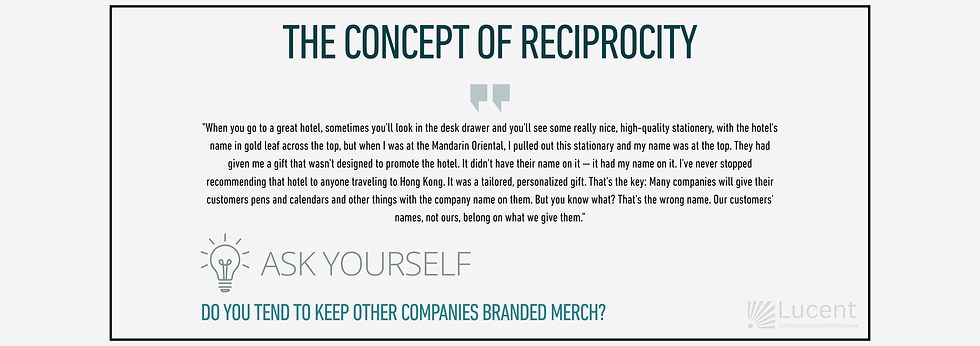
For training sessions incorporated into continuing education programs or referral marketing initiatives, Lucent can provide seamlessly branded materials to support event promotion and deliver a cohesive attendee experience, including custom course flyers, optional discounted printing and shipping, and optional branded course materials such as handouts, program evaluations, and custom stationery.
branded materials
Remote training offers accessibility and scheduling flexibility without compromising session quality. For practices seeking deeper engagement with the material, on-site instruction provides a more immersive experience, with greater audience participation and a higher degree of personalization.
on-site instruction
Training content is designed to be broadly applicable and to stimulate innovation and collaborative problem-solving across the team. For practices seeking a more tailored experience, Lucent accepts Custom Content Proposals, developed following a complimentary Discovery call to determine the most effective approach to adapting existing material before training is scheduled.
customized content
For practices seeking the greatest impact from their training investment, Lucent offers the following options:
double-down on impact.

Complete the form below to start the process of booking your training session or workshop.
Lucent will return your inquiry within 24-business hours.
Lucent is applying for AGD PACE approval for continuing education credit issuance for acceptance by state licensing boards; however, Lucent has not yet been approved and cannot issue continuing education credits at this time. Content is eligible for continued education credit if included as part of an existing AGD PACE approved continuing education program. AGD PACE Course Codes are provided for reference only.
CONTACT.
Image Credit to Alex Andrews