-
Distinguishing between dental plan structures, benefit plan features, and the relationship between dental and medical insurance to develop the working knowledge required to support accurate patient financial guidance and informed treatment decision-making across the full scope of the practice's payor mix
-
Constructing and evaluating a complete insurance eligibility and verification workflow that consistently produces reliable pre-treatment financial estimates and measurably reduces claim adjudication errors and patient accounts receivable
-
Applying behavioral economic principles and solutions-oriented communication strategies to patient financial conversations in a manner that preserves the patient experience while supporting the practice's revenue cycle objectives
-
Integrating insurance literacy, operational verification protocols, and patient-facing financial communication into a cohesive front office skillset that improves collections performance, reduces administrative burden, and positions the practice team as credible, patient-centered advocates for maximizing available dental benefits
turn insurance complexity into operational simplicity.
This three-course series equips front office professionals with clear, actionable steps to simplify dental insurance, improve patient understanding and reduce complexity across daily insurance-related workflows. Profitable revenue cycle management begins with accurate data capture at the time of scheduling, continues through insurance eligibility and verification, and depends on properly calculated and collected patient balances before a successful claims cycle can begin. These sessions address the foundational knowledge that underpins each of these critical workflows, delivering more earned revenue through more efficient processes, while integrating essential business functions seamlessly into the overall patient experience.
Recommended Audience: Administrative Assistants, Check-in, Check-out, Insurance Coordinators, Office Managers, Referral Coordinators, Scheduling Coordinators, Treatment Coordinators
Series Duration: 6 Hours - (3) 2 Hour Sessions
AGD PACE Subject Code Recommendation: 550
INSURANCE SERIES.
SERIES OBJECTIVES
SERIES INVESTMENT: $2,250
Dental insurance is complex, continuously evolving, and by its nature, difficult to track in terms of how it serves patients, how it connects to medical insurance, and what distinctions between coverage types mean in practice. This session provides a clear, practical overview of the most applicable dental insurance fundamentals, equipping the team with the working knowledge needed to improve daily operations, patient understanding, and overall collections.
SESSION I OBJECTIVES
-
Distinguishing between the types of dental plan structures (PPO, HMO/DHMO, government-funded, indemnity, discount plans) and explain how each affects benefit determination and patient financial responsibility
-
Distinguishing between dental and medical insurance structures, including how medical cross-billing applies to select dental procedures, and identifying common scenarios where dual-benefit coordination between dental and medical plans may reduce patient out-of-pocket liability
-
Understanding the origins and current function of FSA and HSA to better assist patients with leveraging all available healthcare financial support without failing to consider needs later in the calendar or benefit year
-
Examining the ongoing evolution of dental insurance plan design and discussing the implications for administrative workflows, fee schedule negotiations, and patient education protocols
-
Drafting a patient-facing explanation of dental insurance benefits that reduces confusion, addresses common misconceptions about coverage, and reinforces the practice's role as a knowledgeable advocate for maximizing the patient's available benefits


SESSION II OBJECTIVES
Building on a foundational understanding of dental insurance structure and function, this session addresses the critical details required for an accurate and efficient insurance eligibility and verification workflow. Verifying benefits prior to every appointment supports predictable, profitable operations and is increasingly an expectation patients bring to their experience with a practice. An optimized eligibility and verification process also carries a less immediately obvious but meaningfully valuable benefit: a measurable reduction in patient accounts receivable and the operational burden that comes with managing outstanding patient balances.
-
Identifying the critical data points required to complete a benefit verification and managing the common errors in data collection
-
Defining key insurance terminology as they apply to verification and treatment planning processes, including coordination of benefits (COB), assignment of benefits, UCR, waiting periods, missing tooth clause, sedation guidelines, deductible, coinsurance, co-pay, benefit maximums, coverage period, frequency, exclusions, and limitations
-
Explain coordination of benefits (COB) rules, including the birthday rule, non-duplication clauses, and primary vs. secondary payer sequencing to understand how these rules govern dual-coverage scenarios for patients carrying more than one active dental plan
-
Constructing an accurate benefits breakdown form that correctly populates preventative, restorative, preventive, basic, and major services coverage percentages and frequency limits for use in developing thorough treatment plan financial estimates
-
Evaluating a completed benefits verification for completeness and accuracy to identify missing or high-risk data elements that could compromise claim adjudication or create post-treatment patient billing disputes


Patient balances are an inevitability regardless of how effectively insurance workflows are designed and managed. This session integrates behavioral economic theory with practical operational processes to support financial conversations with patients in a way that serves both the patient and the practice, preserving the positive patient experience without creating a transactional or high-pressure dynamic for the team.
SESSION III OBJECTIVES
-
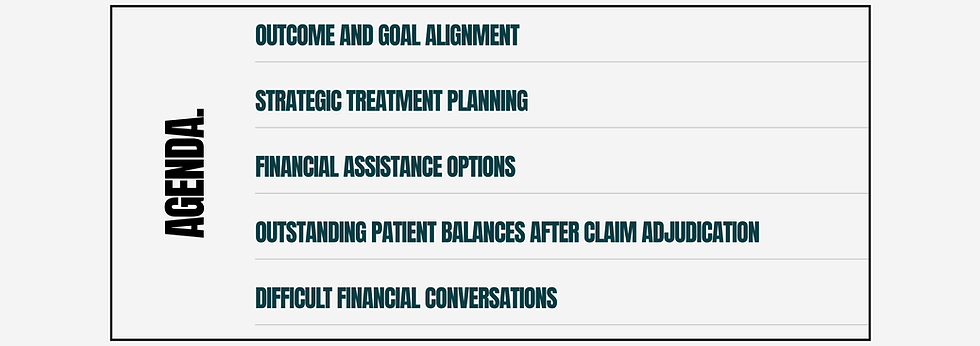
Identifying and acknowledging all clinical options for a healthy outcome to provide options that align with the patient’s intended outcome and their ability to pay
-
Discussing treatment alternatives and/or staged treatment over an extended period of time to improve financial accessibility of both the best clinical outcome and the patient’s intended outcome
-
Evaluating the appropriate use of internal financial assistance options like discounts, structured payments plans, or pro bono work and/or third-party financial partners offering long-term credit-based interest-bearing lending programs
-
Reviewing Explanations of Payment (EOPs) aka Explanations of Benefits (EOBs) with patients whose claims have been fully processed and resulted in an outstanding patient balance
-
Addressing patient conflict arising from financial misunderstanding or difficulty, with solutions-oriented responses that maintain a positive patient experience while maintaining the revenue cycle operative to collect on outstanding balances


double-down on impact.
For practices seeking the greatest impact from their training investment, Lucent offers the following options:
%20-%203_125x%20Resolution.png)
For training sessions incorporated into continuing education programs or referral marketing initiatives, Lucent can provide seamlessly branded materials to support event promotion and deliver a cohesive attendee experience, including custom course flyers, optional discounted printing and shipping, and optional branded course materials such as handouts, program evaluations, and custom stationery.
branded materials
Remote training offers accessibility and scheduling flexibility without compromising session quality. For practices seeking deeper engagement with the material, on-site instruction provides a more immersive experience, with greater audience participation and a higher degree of personalization.
on-site instruction
Training content is designed to be broadly applicable and to stimulate innovation and collaborative problem-solving across the team. For practices seeking a more tailored experience, Lucent accepts Custom Content Proposals, developed following a complimentary Discovery call to determine the most effective approach to adapting existing material before training is scheduled.
customized content
For practices seeking the greatest impact from their training investment, Lucent offers the following options:
double-down on impact.

Complete the form below to start the process of booking your Insurance Series.
Lucent will return your inquiry within 24-business hours.
Lucent is applying for AGD PACE approval for continuing education credit issuance for acceptance by state licensing boards; however, Lucent has not yet been approved and cannot issue continuing education credits at this time. Content is eligible for continued education credit if included as part of an existing AGD PACE approved continuing education program. AGD PACE Course Codes are provided for reference only.
CONTACT.
Image Credit to Alex Andrews